

How retailers and telecom companies can offset the drop in sales of new electronics
The full cycle, from trade-in to refurbished devices you can trust. Based on remarks made by Breezy co-founder Andrii Kosar at IFA 2026 in Berlin. The topic for which I was invited to speak at TechTalk @ Reseller Park as part of IFA 2026 was: “From Trade-In to Trusted Refurbished: Closing the Loop for Retailers,…
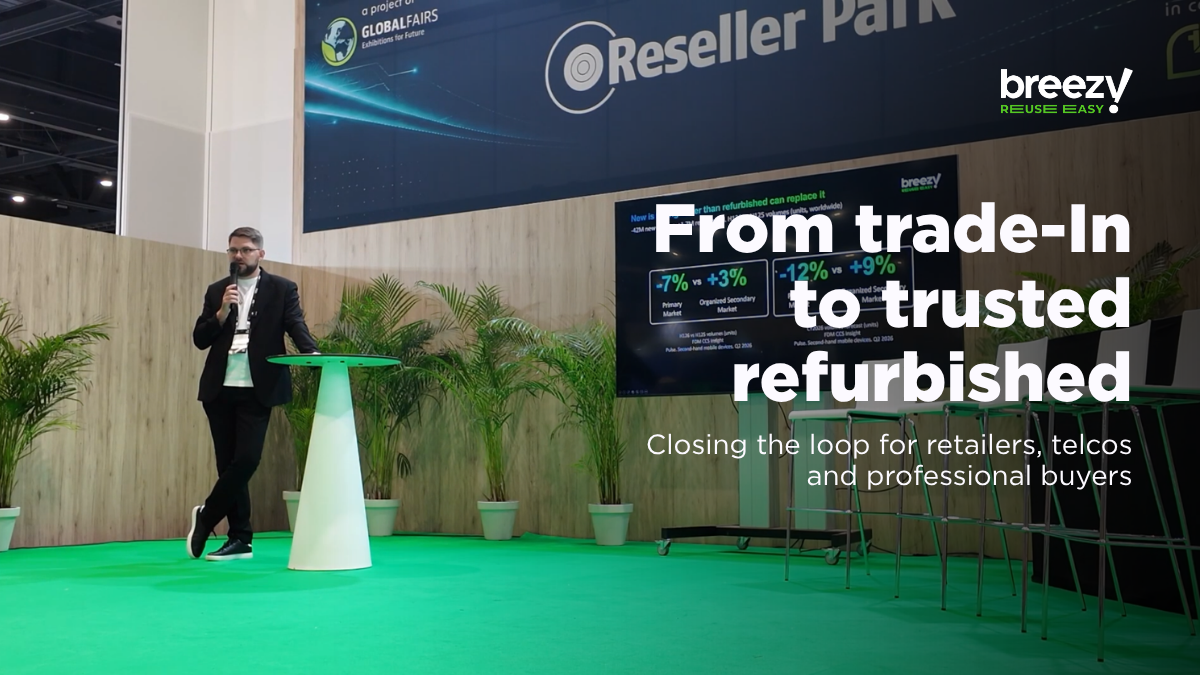
The full cycle, from trade-in to refurbished devices you can trust. Based on remarks made by Breezy co-founder Andrii Kosar at IFA 2026 in Berlin.
The topic for which I was invited to speak at TechTalk @ Reseller Park as part of IFA 2026 was: “From Trade-In to Trusted Refurbished: Closing the Loop for Retailers, Telcos, and Professional Buyers.” Twenty minutes on stage is always a compromise. Below is what I managed to cover, along with a few points I didn’t have time to address.
I’ll start with a statement that surprised some of the audience: the main competitor to trade-ins is neither another buyer nor a marketplace. This is a desk drawer. He offers the customer zero and still comes out ahead in most cases. This isn’t a metaphor—here are the numbers.
1. The market itself conducted an experiment on behalf of all of us
There has long been debate in the industry about how price-sensitive consumers are when it comes to trade-in values. By 2025, that debate was no longer necessary. Vendors and carriers were widely offering additional payments for trade-ins—on average, about €100 above market value. In 2026, these programs were phased out. Between the two periods, exactly one significant variable changed.
● Average device replacement cycle: 3.6 years in 2024 → 3.2 years in 2025 → 3.5 years in 2026 (forecast);
● Share of newer generations (N‑1…N‑3 from the latest model) among returned devices: 43% → 58% → 50%.
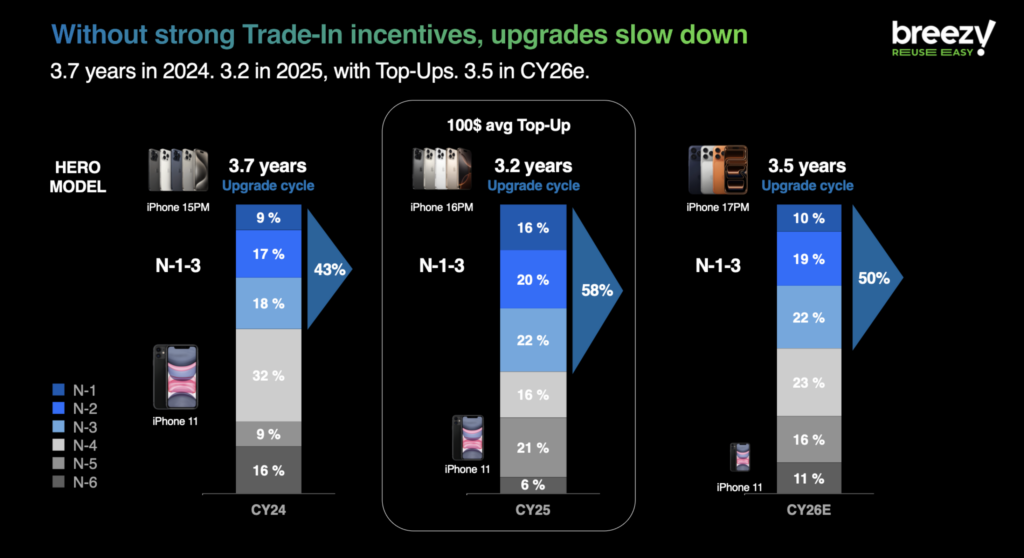
The first thing that follows from this is that flexibility in trade-ins is real, measurable, and fast. The offer responds to a customer’s request within a single sales cycle, rather than over years of shaping consumer habits. This is good news for anyone with retail locations.
Second, less obvious but more important: the premium affects not only the volume but also the quality of the flow. In CY25, the share of fresh harvests—the most liquid inventory—increased. When the premium was removed, those were the first to disappear. In other words, when volume drops, you also lose out on the average quality of what you did manage to collect.
It is important to note that the data for 2026 are projections, as the year is not yet over. During that same period, the market was affected by a memory shortage and rising prices for new devices, and it is not possible to completely isolate their impact. However, there is no doubt about the direction and speed of the market’s response.
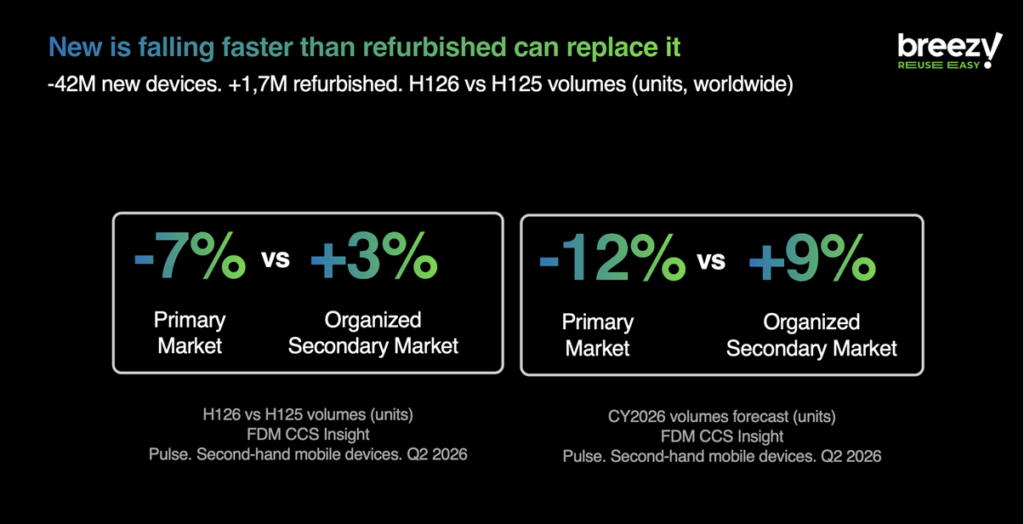
2. There is sufficient demand in the secondary market. There is a shortage of devices.
In the first half of 2026, the primary smartphone market contracted by 7% year-over-year, while the organized secondary market grew by 3%. This represents 42 million fewer new devices compared to 1.7 million refurbished units. The secondary market compensates for only about 4% of the primary market’s losses. The forecast for the year is −12% and +9%, respectively.
In Europe, the picture is even clearer. Approximately 21 million refurbished devices are sold each year, and about 15 million are received through trade-in programs.
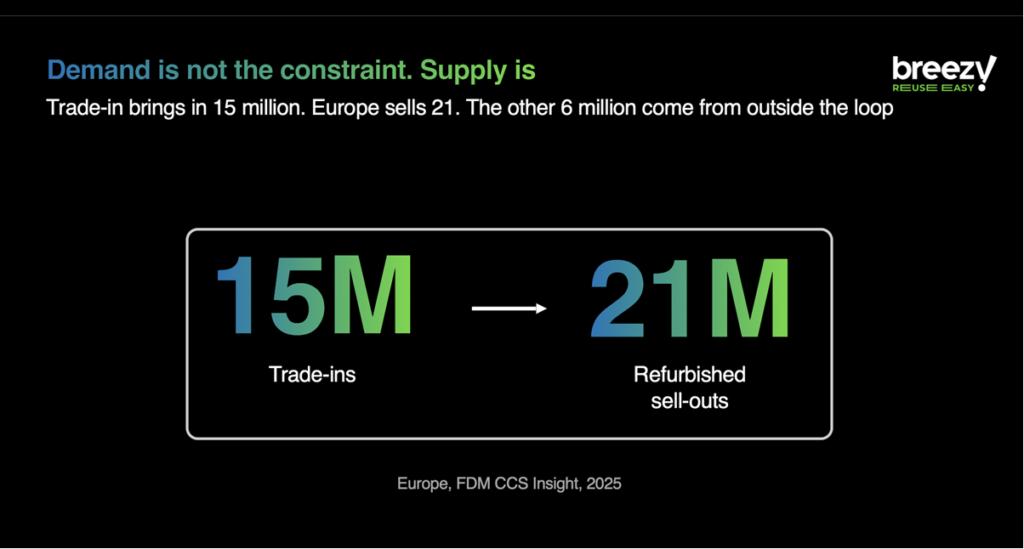
Data for Europe, Source: FDM CCS Insight, 2025
The remaining 6 million come from outside Europe—primarily from the U.S. And here lies a risk that the market has yet to fully appreciate: the U.S. trade-in market is shrinking. Some carriers are removing the trade-in requirement from their offers for new models, while others are tightening their trade-in terms. The European secondary market relies half on a source that is shrinking—and it can only be replaced by local trade-in programs.
3. The devices are available. They just don’t make it here.
According to our estimates, the breakdown is as follows: only 9% of devices are returned to the organized market through trade-in programs. 10% are sold by the owners themselves, 27% are given to family members, and 54% are kept at home.
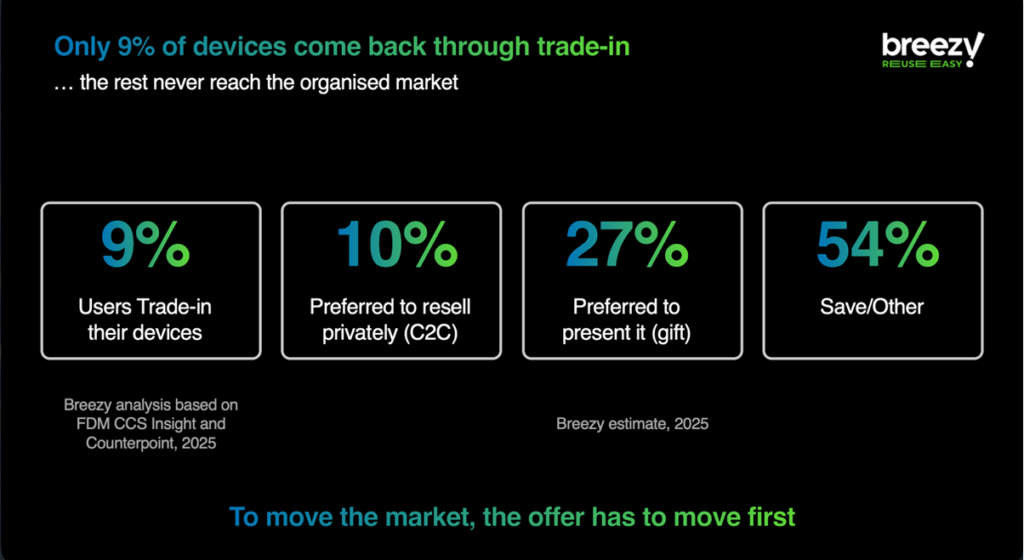
Source: Breezy analysis based on data from FDM CCS Insight and Counterpoint, 2025
54%—these aren’t “lost” devices. They’re devices that no one is seriously competing for. A desk drawer offers neither price, nor convenience, nor guarantees—and yet it still wins out, because the “do nothing” option requires no effort on the user’s part.
It’s not environmental concerns or convenience that work against it. It’s simple math. According to our data, the device loses about 1% of its value per week —roughly 41% over a year of inactivity. When you explain this to a customer in a single sentence, the decision is made noticeably faster. It’s the cheapest conversion tool you have, and it doesn’t cost a cent.
4. Three conditions without which the program does not work
This isn’t about a specific provider’s technology. These three things must be in place for anyone who is serious about trade-ins.
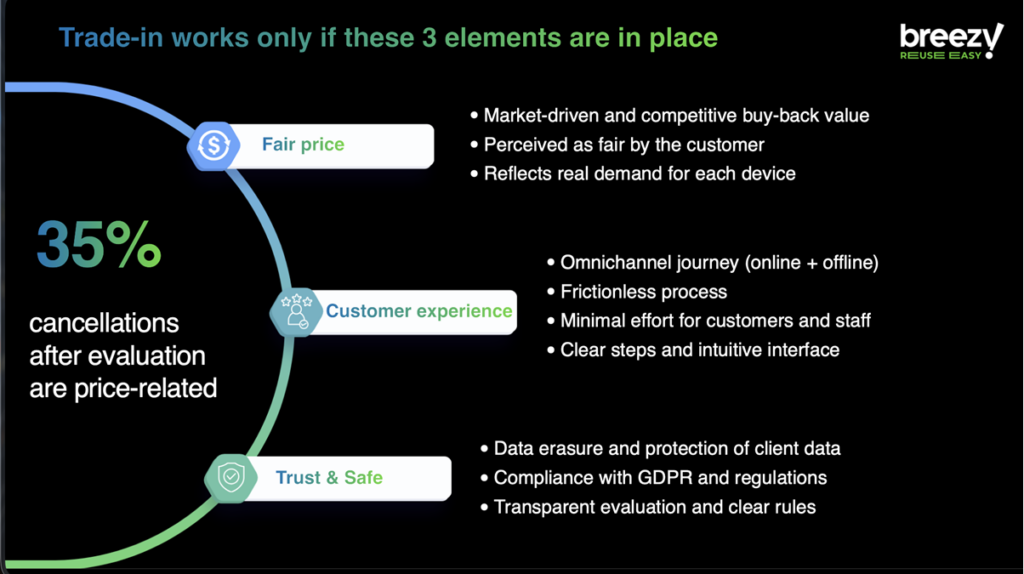
A slide from the presentation
A fair price. According to Breezy, 35% of drop-offs after an estimate are due to price. This is the most costly drop-off in the sales funnel: the customer has already come in, has already agreed to an estimate, and has already spent both their time and yours. A fair price is determined by a combination of three factors: the market and competitive buyback rates, the customer’s perception that the price is fair, and a reflection of the actual demand for a specific model at a specific time.
A Seamless Customer Journey. A customer starts their journey on social media, continues in the app, and finishes in the store—or vice versa. A quote provided online should carry through to the checkout without any recalculations. Most software is still optimized only for brick-and-mortar stores, and it’s precisely at the intersection of these channels that some customers who have already agreed to make a purchase are lost.
Trust and Data. For me, this was the biggest revelation of the year. About 20% of those who keep the device at home do not hand it in precisely because they fear for their data. These findings are also confirmed by independent research agencies. CCS Insight, based on a sample of 3,000 respondents, cites this reason as accounting for 25% of all barriers to trade-in. The issue isn’t communication, but rather certified data erasure, a document provided to the customer, and a clear explanation of what that document means.
5. Why a single buyer cannot ensure a fair price
Today, the accuracy of assessments depends on technology: AI-based condition assessment, process automation, and the use of official diagnostic tools. Breezy isn’t the only one working on this—Grigory Glazman from NSYS spoke about it on the same stage, which means this is an industry-wide challenge that cannot be solved alone.
But accuracy is only half of a fair price. The other half is demand. A single buyer sees only one side of the market: their own channel, their own product grades, and their own inventory levels. We carry over 14,000 SKUs, including laptops, and I’ll be blunt: no one—including us—can offer the best price across this entire list. This is a structural limitation of any single-source model.
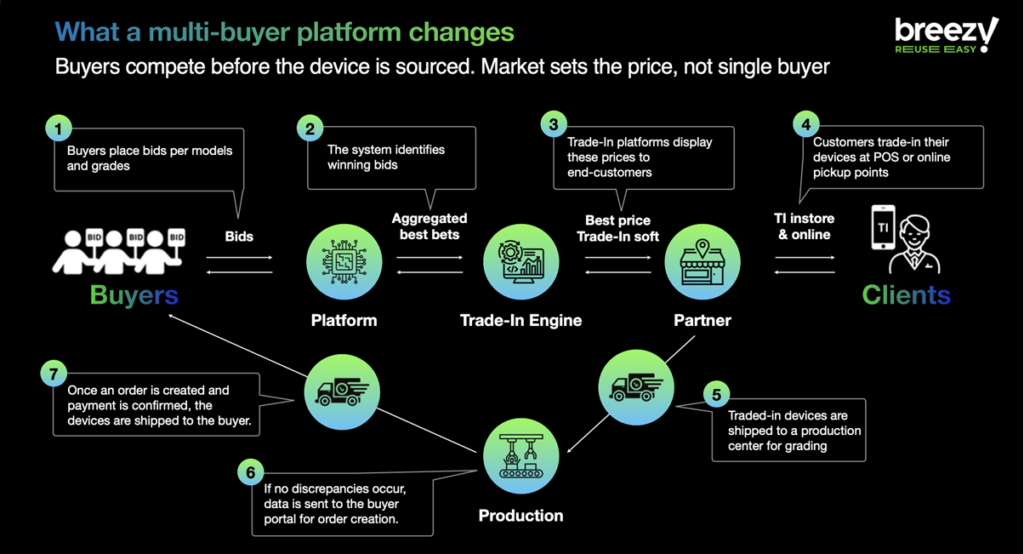
Slide from the presentation: how the multi-buyer model works
This requires a multi-buyer approach: buyers place bids based on the model and grade before the device is purchased through a trade-in. The platform then aggregates the bids—and the retail customer who brought in their device sees the market price rather than a single buyer’s offer. The key point here is not technological but commercial—the price is set by the market, not by a single buyer. The retail partner no longer bears pricing risks, and buyers receive a predictable supply of devices.
6. What this means for retail and telecom: six questions
If you sell electronics, here are some questions you should answer before launching or relaunching a trade-in program. The order matters.
1. What percentage of total new device sales are trade-in transactions? If you don’t know, it’s worth calculating. If you can’t give an exact figure, then you don’t have a program—you have a promotion.
2. How many customers drop out after the evaluation, and for what reasons? Without this breakdown, you won’t know exactly where you’re losing them.
3. Does the online estimate hold up at the register without being adjusted?
4. What does the customer take home from the store as proof that their data has been deleted?
5. Who bears the risk of a grade discrepancy—you or your buyer? If it’s you, that’s a hidden drain on your margin that doesn’t show up in any report.
6. Does at least some of the stock you’ve collected end up on your own shelves—or does it all go to wholesalers?
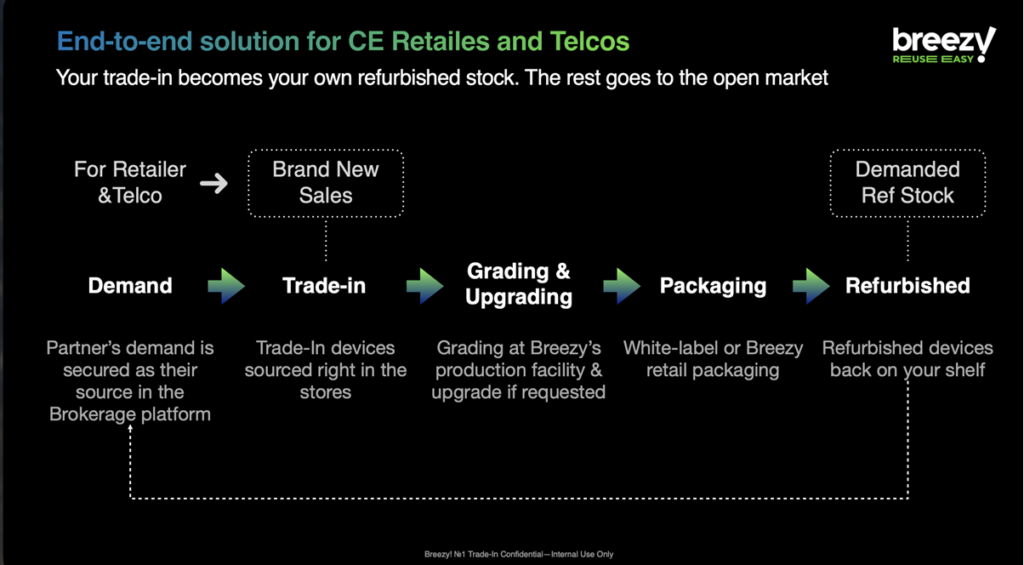
Slide from the presentation: a closed-loop system for retail and telecommunications
The last question is the most expensive one. Selling refurbished devices through its own retail network yields a significantly higher selling price than wholesale, and it is precisely this difference that funds a higher buyback offer. A retailer who sells the entire volume wholesale is effectively financing someone else’s profit margin—and then wonders why trade-in volumes are so low. At the same time, trade-ins benefit both parties to the transaction immediately: they make new devices more affordable and accelerate replacement—50% of customers who buy a new device through a trade-in also purchase accessories or services.
7. Where is it going?
My take: Trade-in is becoming the foundation for the next phase—affordability. In markets such as Central Asia, up to 70% of new device purchases are already made through installment plans. As prices for new devices rise, trade-ins are no longer just a promotional tool but have become a mechanism that enables customers to make a purchase at all.
The implication for the market is simple. Companies that haven’t yet learned to buy back devices through trade-in programs will end up buying them from those who have—at someone else’s price and in someone else’s volume.
A deal isn’t made out of thin air. It’s sealed. And it all starts with a fair price.

Why leading IT companies choose Breezy’s B2B Trade-In
In the IT industry, hardware is more than just a tool — it is the foundation of development. Computing power directly affects compilation speed, developer productivity, and ultimately, product success. That’s why software companies refresh their equipment regularly and on a fixed cycle. At the same time, managing end-of-life devices is far from simple. It…
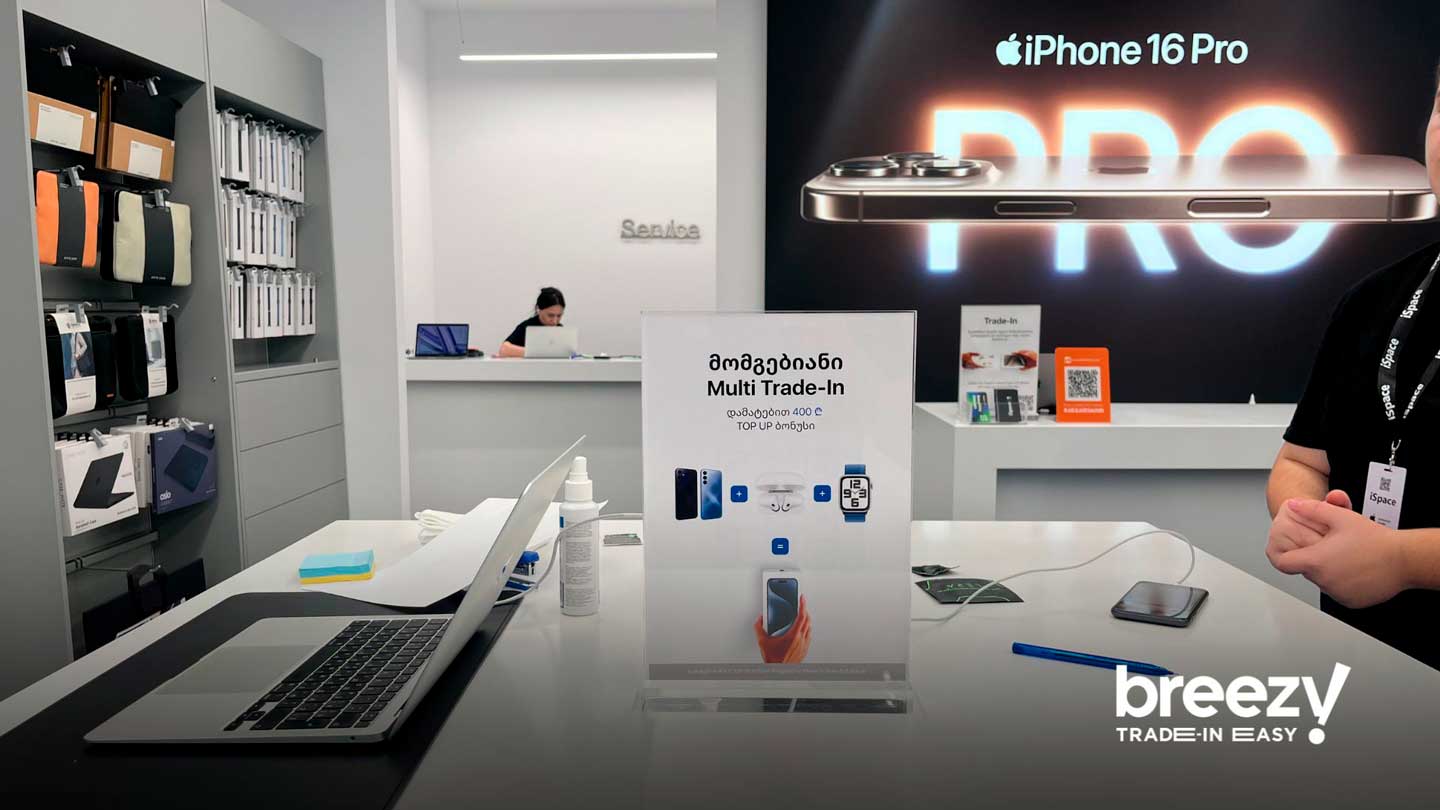
The share of new iPhones purchased through Trade-In increased by 60%
Breezy partners understand that Trade-In is a powerful tool for boosting new device sales. By trading in old devices, customers can cover a significant cost of their purchases, which encourages them to upgrade more frequently, opt for higher-end models, and invest in high-margin items like accessories and additional services. The best results from Trade-In…
How a business can upgrade its equipment quickly and profitably
Bayer, Coca-Cola, EVO, and SQUAD share how Breezy helped them effortlessly and safely sell out their old equipment. They also explain how to use old devices as pay for new ones, purchase twice as much equipment as the budget initially allowed, and even sell used gadgets to employees, sometimes within a tender procedure. Laptops,…
 International
  Ukraine
  Poland
  Georgia
  Kazakhstan
  Cyprus
  Azerbaijan
  Moldova