

The future of circular IT: Key insights from Retech Days Business 2025
On November 27, Breezy attended Retech Days Business 2025 — one of the key events in the circular IT and sustainable electronics industry.Our colleague Maria Yanchenko took part in a panel discussion focused on device lifecycle extension, end-of-life management, quality standardization, and building trust in refurbished technology. For those who couldn’t attend, we’ve gathered the…
On November 27, Breezy attended Retech Days Business 2025 — one of the key events in the circular IT and sustainable electronics industry.
Our colleague Maria Yanchenko took part in a panel discussion focused on device lifecycle extension, end-of-life management, quality standardization, and building trust in refurbished technology.
For those who couldn’t attend, we’ve gathered the key insights that strongly resonate with our work at Breezy.
1. The stigma around used devices persists — and the market is learning how to overcome it
The panel “How To Tackle The Used Stigma: Consumer Trust, Grading & Quality Assurance” addressed why, despite rising awareness, users are still cautious about refurbished devices.
As Simone Sievernich, General Manager Hard Goods at eBay, noted: “Awareness is growing, but still comparatively low… If you haven’t had a good experience, the perceived risk of buying something used is inherently higher compared to new.”
Simone emphasized that consumers assess risk before they recognize value — and the industry’s task is to make this risk predictable and manageable.
This is why eBay continues to expand its eBay Refurbished program, where only verified sellers participate and quality is standardized.
2. Without grading standardization, the market cannot grow
The same panel highlighted the urgency of having unified grading terminology. As one of the speakers stressed: “Standardization would be like the lingua franca of refurbishment… it is needed.”
Today, A/B/C grades differ by seller, creating confusion and eroding trust.
At Breezy, we consistently emphasize that developing an industry-wide standard is one of the essential steps toward market maturity.
3. Value for consumers comes not only from price — but from transparency
As Alexandra Asanache, Sustainability Solutions Consultant at Lenovo, pointed out: “Price attracts attention, warranty creates safety, and grading accuracy and communication create trust.”
Alexandra also shared how Lenovo is actively developing circular solutions:
refurbishing devices in-house, replacing batteries below 80% capacity, repainting housings, performing up to 35 tests, and returning devices with a renewed warranty.
This demonstrates how manufacturers are becoming active contributors to circularity, rather than just observers.
Many speakers highlighted that companies want visibility across the entire process — from device drop-off to resale or recycling.
As one panelist put it: “Typical ITAD processes create complexity, silos, delays… customers wait weeks not knowing what’s happening with their devices.”
Real-time platforms solve this problem by giving companies transparency at every step — status updates, photos, MDM removal, audit trails, and compliance documents.
4. Sustainability is no longer the main driver
Over the past year, ESG motivation has declined in the corporate sector, while financial motivation has increased.
As Breezy CEO Andrii Kosar puts it: “First economy, then ecology.”
One of the speakers summarized this shift: “Sustainability has fallen down the agenda… today price and quality matter much more than a year ago.”
Still, participants agreed that sustainability will return to the forefront — driven by regulation and investor expectations.
5. Five billion unused devices is a huge opportunity
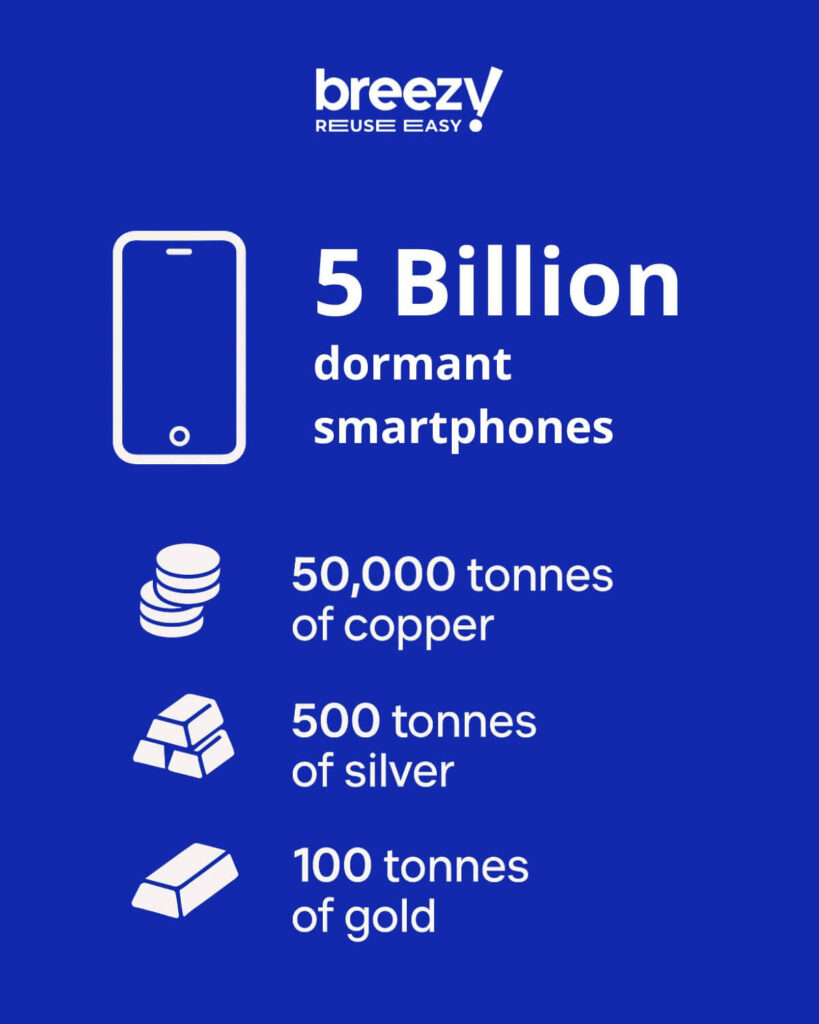
As Conor Dempsey, Senior Director, GSMA Services & GSMA Intelligence, shared, there are 5 billion dormant smartphones sitting in drawers today.
They contain:
- 50,000 tonnes of copper
- 500 tonnes of silver
- 100 tonnes of gold
A vast unused resource.
Conor emphasized: “If we can get just 1% of those devices back, that’s 50 million phones.”
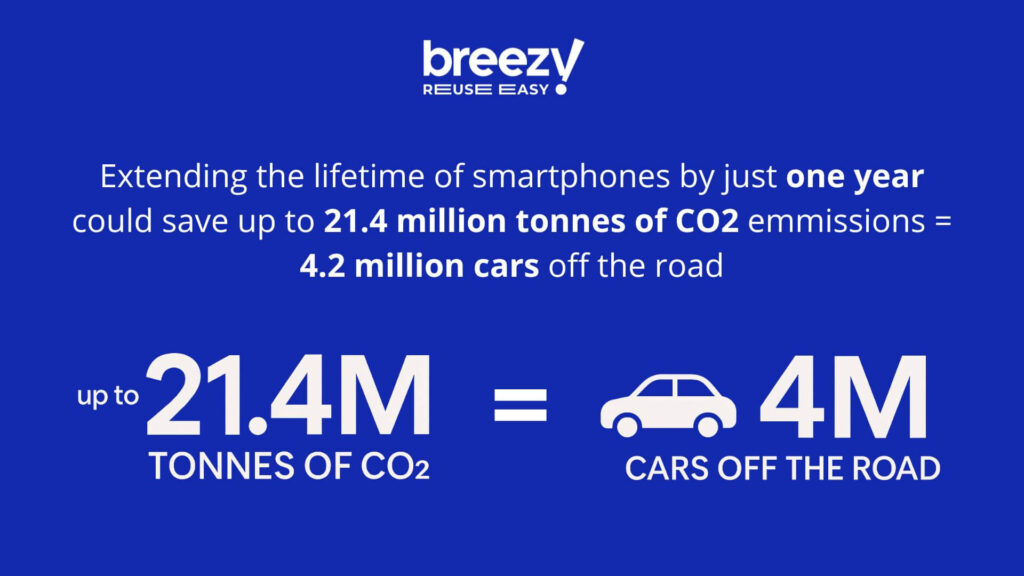
Extending the lifetime of smartphones currently in circulation could reduce CO₂ emissions by 21.4 million tonnes per year — equivalent to removing 4.2 million cars from the road.
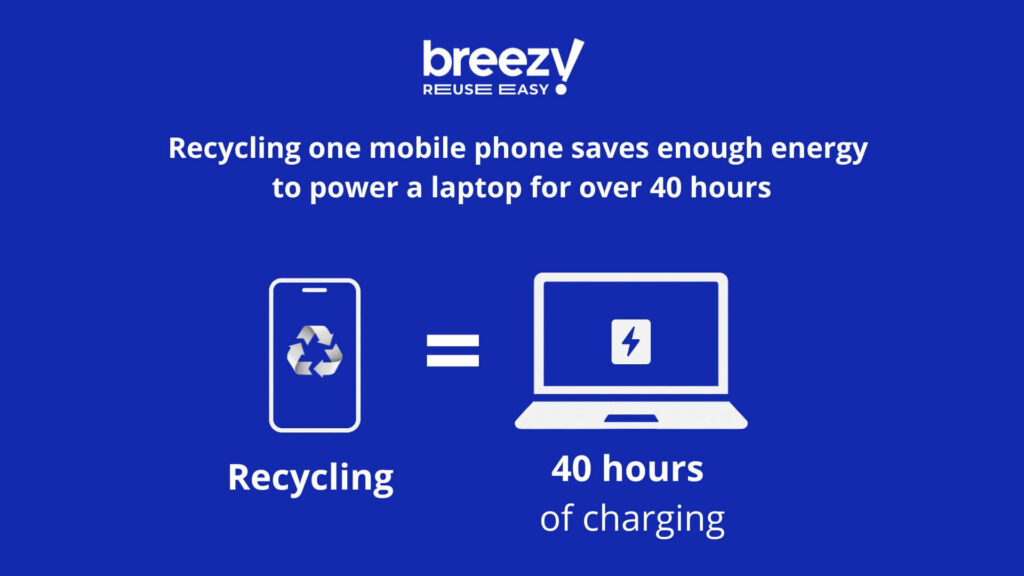
Meanwhile, recycling just one mobile phone saves enough energy to power a laptop for over 40 hours. This represents an enormous amount of material, carbon, and economic value that remains untapped.
6. Data security remains companies’ biggest concern
Many speakers stressed that companies still underestimate the risks associated with improper end-of-life handling.
For example, physical shredding does not always guarantee security: many microchips are smaller than standard shred sizes, and data can be extracted from larger fragments.
This is why the market is moving toward certified data erasure, detailed audit trails, and strict oversight of downstream processing.
Yet not all companies approach data deletion with the same level of rigor. As Maria Yanchenko, Head of B2B Trade-In, accurately observed:
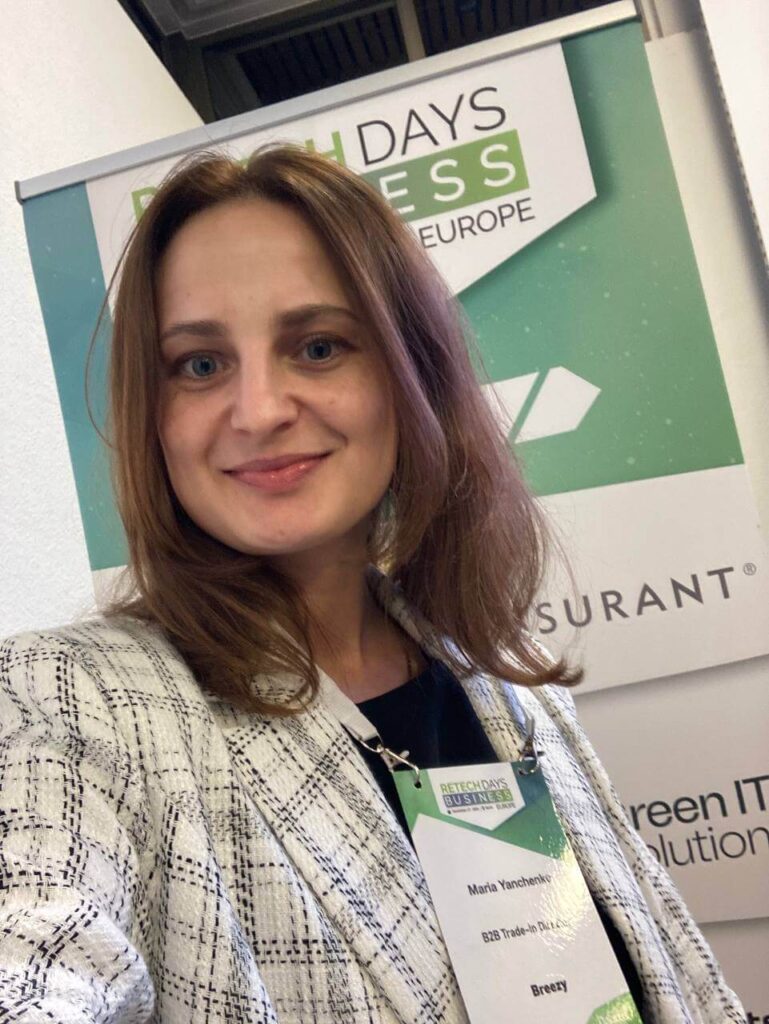
“The market perfectly follows a Gaussian ‘bell curve.’
On one side of it, there are rare cases where companies take a surprisingly casual approach — we sometimes even receive devices with corporate email windows still open.
On the other side, there are companies with highly regulated policies and strict compliance protocols, where every data-wiping step is clearly documented.
But most cases sit comfortably in the middle of the curve: these companies just want reassurance that their data won’t fall into the wrong hands, without being overly concerned about the exact technical method.”
7. The evolution of corporate approaches to end-of-life management
Corporate End-of-Life management has changed significantly in recent years. As Maria Yanchenko explained:
“More and more organizations are beginning to build structured ITAD processes — from assigning responsible teams to implementing internal procedures and performance assessments. Many companies are moving away from storing unused devices and shifting toward trade-in programs or environmentally responsible disposal. We also see growing collaboration between IT departments and sustainability teams: equipment renewal is becoming not just a technical necessity but a strategic component of business efficiency.”
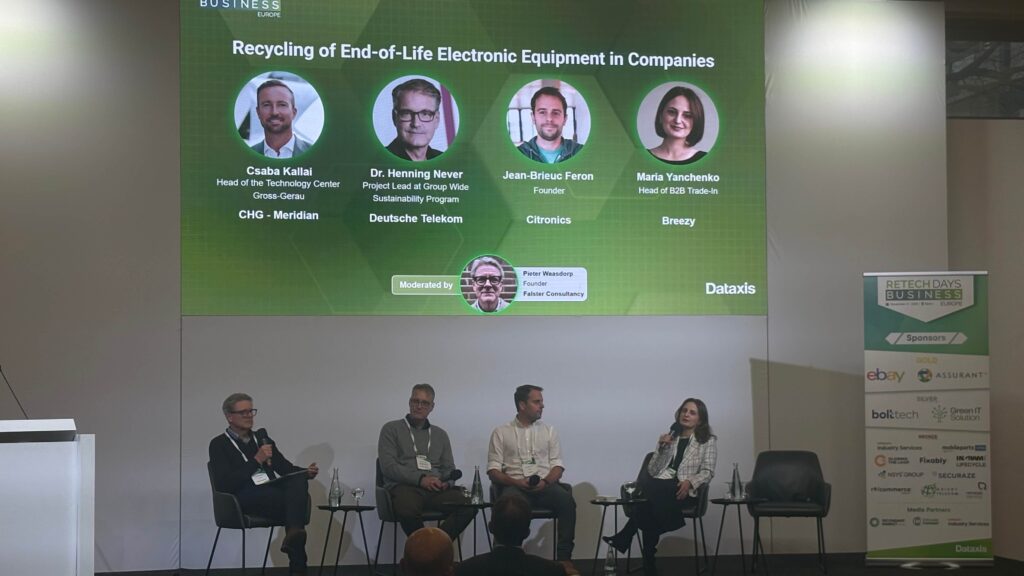
She also noted the main challenges companies face:
“For those just starting this journey, the main difficulties are the lack of internal policies, lack of expertise, poor visibility of devices, and uncertainty about when equipment actually needs to be replaced. Many companies still don’t track serial numbers, which complicates asset write-off and leads to additional costs.”
And she highlighted what businesses value most in a partner:
“Most companies simply want reassurance that their data won’t fall into the wrong hands. They don’t necessarily care about the technical method, but they do want guarantees of security, traceability, and certified data destruction.”
At Breezy, we aim to build a comprehensive device buyback process that any company can easily use — regardless of internal procedures, staffing or compliance requirements.
8. Where the industry is heading: services, standards and simplicity
Speakers reached an unusual level of consensus:
- the future belongs to service-based models (DaaS, leasing, subscription)
- the market needs unified quality terminology and grading standards
- simplicity and transparency are the foundation of trust
- large retailers and telecom operators will play a significant role in market growth
- EU regulation on circular economy will accelerate adoption
What this means for the market
- the industry is maturing rapidly and moving toward sustainable and cost-efficient models
- transparency, traceability, and security are becoming must-haves
- devices are becoming part of companies’ ESG strategies
- demand for extending device lifecycles continues to rise
Breezy stands at the intersection of IT, finance, and sustainability — and we continue developing solutions that help companies manage their devices more responsibly, more safely and more efficiently.
Retech Days reaffirmed that our vision is fully aligned with the future of the industry.
What will end the era of greenwashing in tech: insights from MWC 2026 Barcelona
Imagine this: a Fairphone can be disassembled with a screwdriver in minutes and used for 7 years, while Deutsche Telekom shuts down base stations for milliseconds at a time—resulting in lower connectivity costs for customers. The Breezy team, including CEO Andrii Kosar and Trade-in Product Manager Jan Mazur, has returned from MWC 2026 in Barcelona….

The global сircular economy roadmap: trends, barriers and the new “standard of frictionless trade”
The global secondary smartphone market has reached a critical turning point, evolving from a niche “green” initiative into a sophisticated financial instrument for digital affordability. These shifts were the focal point of the Circular Market 2026 conference in London, where industry leaders shared their observations and strategic insights. As noted by Breezy CEO Andrii Kosar…

The secondary market as the new center of gravity: Insights from Circular Markets London 2026
The secondary mobile device market is no longer a supporting channel — it is becoming a structural driver of revenue, retention, and long-term margin stability across Europe. At Circular Markets London 2026, Breezy CEO Andrii Kosar and Trade-in Product Manager Jan Mazur joined industry leaders to discuss the shifts redefining the market: affordability replacing sustainability…
 International
  Ukraine
  Poland
  Georgia
  Kazakhstan
  Cyprus
  Azerbaijan
  Moldova